What SDR leaders look for: lessons from Dave Wilkins.

You sent the application. You rewrote the CV. You read the cover letter three times at 11pm.
Then nothing. Or an email saying they went with someone more experienced.
We asked the people on our last webinar why they weren't hearing back. 40% said they had no tech experience. Another 40% said there were too many applicants.
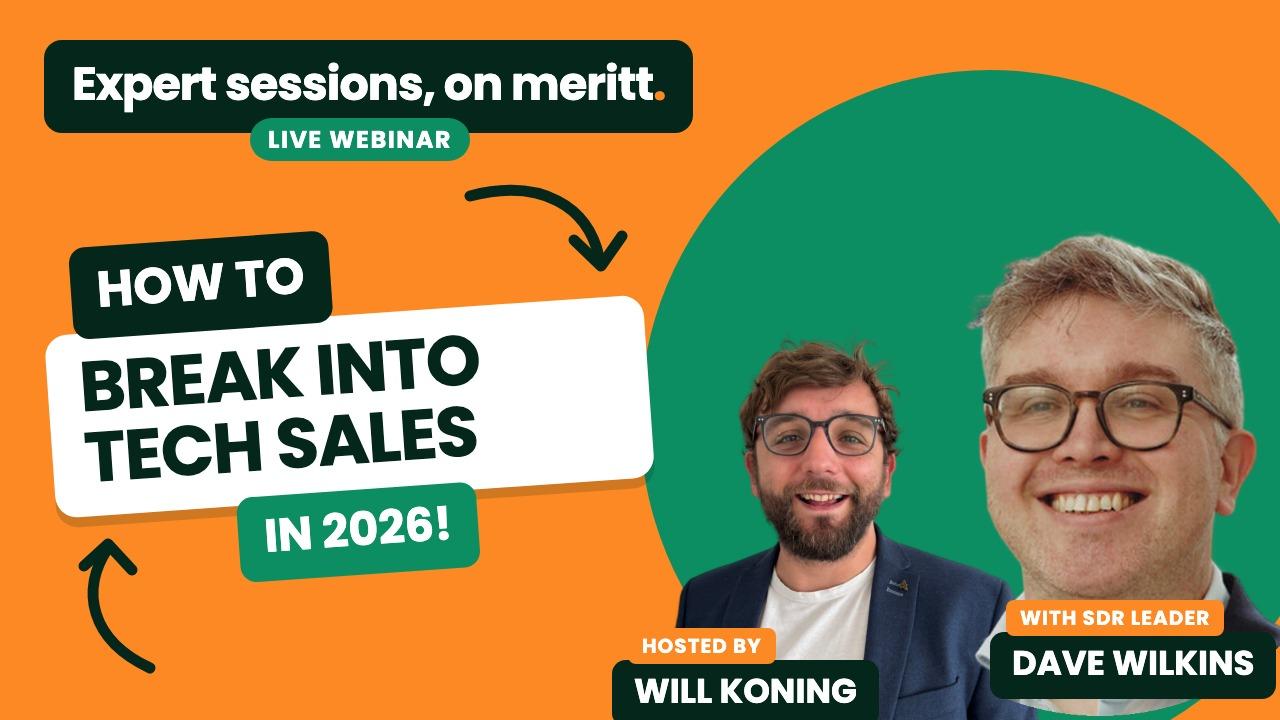
So we put that to someone who knows. Dave Wilkins is the founder of SDR Leaders Global, a community of more than 20,000 people who run SDR teams. He started out as an SDR himself. On 6 November he joined Will Koning, the founder of meritt, for a live session on what SDR leaders look for when they hire. Here is the full recording, and the parts that matter most.
Call the person who can hire you.
Will asked how SDR leaders feel about candidates getting in touch directly. Dave's answer took two words: "Call them."
Last year, Dave posted on LinkedIn that he was looking for an SDR. The post came with one promise: "You will get an interview if you cold call me."
I had 20, no, 35 messages on LinkedIn, and none of them got interviews. And the three people that cold called me, they got interviews.Dave Wilkins, Founder, SDR Leaders Global
The people who hire SDRs want to see that you can do the job. A call shows that in a way a message can't. It doesn't even have to go well. "It could be an absolutely terrible cold call, but you've got to try at least," Dave said.
Finding the number is often easier than you think. "A lot of the time, SDR leaders have their phone number on their LinkedIn profile," he told us. He called that "a surefire signal that you should call them."
What "no experience" really tells you.
Everyone on the session knew the trap. No experience, no job. No job, no experience. Dave has no patience for it. "I hate this as an excuse," he said.
If a hiring manager says that to you, Dave's advice is to move on. To him, it says that manager will not coach you to be better.
You have dodged a massive red flag.Dave Wilkins
He has hired someone who sold dirt bikes in Australia. He has hired primary school teachers from America. His first BDR job was at a company that had just had a huge IPO, and he had no idea what an IPO was.
I don't care if you have experience or not. It's about the attitudes that you have.Dave Wilkins
Will added the part you can act on today. You can't change having no experience. You can change how you come across. Say it first: "I know I'm not experienced. But what I do know is that I've invested in myself. I'm learning how to cold call. I am cold calling you now to get this interview."
Start doing the job before you feel ready.
Will asked what Dave would do with 30 days, starting from zero. He would not spend them reading about cold calling.
"You've got to do the skill," Dave said. "You have to do it because that's where you learn the best." The best reps he has seen get on the phones within their first couple of days.
If that sounds terrifying, it is. Dave still remembers his first cold call, and the cold sweat that came with it. "It was the most terrifying thing ever," he said. "But you just have to keep doing it."
Why the phone still matters in the age of AI.
You might expect AI to have killed the phone. Dave's numbers say otherwise. When SDR Leaders Global surveyed its members, the phone came out as the top channel for booking meetings.
74% of all meetings were booked via the phone.Dave Wilkins, on the SDR Leaders Global survey
And email? "Not a lot," said Dave.
Will's point was that the more emails and automation there are, the more a real voice stands out. So the question to ask yourself is simple. Can you honestly say you can cold call?
That gap is why we built the meritt programme. You practise real calls out loud with an AI voice coach that pushes back, then we help you get seen by the people who hire.
Be the rep people want to coach.
Dave ranked what SDR leaders care about most. Resilience came first, then being coachable, then being curious. Being a good talker came last.
He told a story to show why. Two reps joined his team at the same time. One was humble, always wanting to get better. The other thought he knew everything. Five years on, the first is a regional sales manager. "That second person is still an SDR after five years," Dave said.
Feedback is how you tell which one you are. It can sting, but as Dave put it:
People don't give you feedback if they don't care.Dave Wilkins
Make your odd CV make sense.
Dave's own route was anything but neat. He struggled with exams because of dyslexia, played rugby in the Netherlands, went back to England to become a teacher, then moved back to Amsterdam with £750 and worked in a mayonnaise factory. Then a recruiter messaged him. "She said you've got no sales experience, but you've done coaching," he told us.
The lesson is about how you tell it. As Will said, a list of random jobs sounds all over the place. Explain why those jobs together make you a great SDR, and they become your best asset. Retail, a coffee shop or a bar all count, Dave said, because they show you can handle high pressure.
What to do this week.
Pick three SDR leaders who are hiring. Check their LinkedIn profiles for a number. Practise what you will say until you can say it without reading it. Then call. If you want more on how to open that call, read our guide to the structure of a great cold call.
Common questions about what SDR leaders look for.
What do SDR leaders look for when hiring?
On our session, Dave Wilkins ranked it in this order: resilience, being coachable, being curious, then being a good talker. That order surprises a lot of people, because they assume talking comes first. SDR leaders know they can teach a script. It is much harder to teach someone to keep going after a bad day on the phones or to take feedback well. Show those traits before the interview if you can. Calling the hiring manager shows resilience. Asking for feedback after a practice call shows you are coachable. Asking good questions about their team shows you are curious.
Is it OK to cold call a hiring manager about an SDR job?
For an SDR role, yes. Calling is the job, so the call is your first work sample. When Dave Wilkins asked people to cold call him about a role, the 35 who sent LinkedIn messages got no interview and the three who called all did. Many SDR leaders put their number on their LinkedIn profile, and Dave reads that as a sign you should use it. Keep it short. Say who you are, why you are calling and what you are asking for. It does not need to be perfect. Trying is what they notice.
What should I do if an employer says I have no experience?
Do not argue with it. You cannot change it, so say it first and move on to what you can prove. Tell them you know you have not done the job yet, then show what you have done to get ready: practice calls, what you have learned and any training you have finished. Link your past work to sales too. Bar, retail and coffee shop jobs all show you can stay calm under pressure. And remember Dave's view. If a hiring manager rejects you only for having no experience, they may not be the person who would coach you anyway.
Do SDRs still cold call in 2026?
Yes, and the phone is still the top channel. In a survey of SDR Leaders Global members, shared by Dave Wilkins on our session, 74% of meetings were booked via the phone. Email came in well behind it. As more outreach gets automated by AI, inboxes fill up and a real voice stands out more. That is why cold calling remains the core skill for a new SDR. If you are applying for your first role, expect to be asked if you can do it, and practise out loud before you are asked to prove it in an interview.
Hire great salespeople, better.
Sales people who recruit sales people. A flat fee, a shortlist with evidence, and a process candidates rate 4.8.
See how we hire